
Sale!

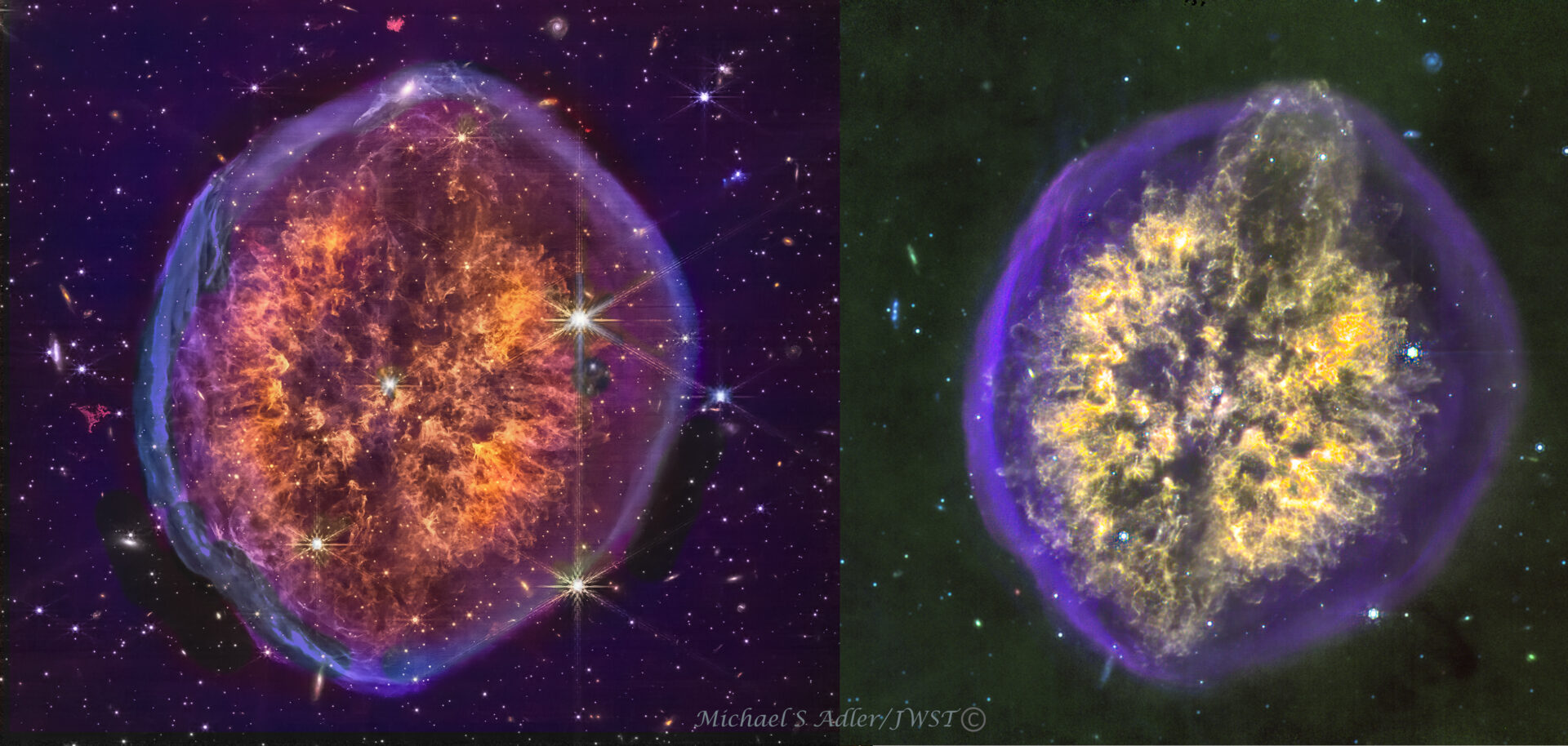
PMR1, Cranium Nebula JWST(NIRCAM & MIRI)

Original price was: $65.00.Current price is: $52.50.

PMR1 Exposed Cranium Nebula JWST

The Exposed Cranium nebula (also known as PMR 1) is a planetary nebula located roughly 5,000 light years away from Earth in the constellation Vela.  Its name “exposed cranium” comes from the nebulas describe the uncanny resemblance to a brain located in a transparent skulll. This appearance is made possible by a dark lane running vertically down the middle of the nebula.The nebula is formed from a large and hot dying star ejected material out into space. It is unknown whether this star is massive enough to undergo supernova or just shed its outer shell of material like our Sun will do. The nebula appears to have distinct regions that capture different phases of its evolution — an outer shell of gas that was blown off first and consists mostly of hydrogen, and an inner cloud with more structure that contains a mix of different gases.

NASA’s James Webb Space Telescope captured the images using its NIRCAM(near infrared camera) and its MIRI(mid range infrared camera)  in March 2025. The NIRCAM image on the left is in false color with Red from its 4.7u filter, Green from the 4.44u filter, and Blue from the 1.87n filter. The MIRI image on the right had 18.0u as Red, 12.8u as orange, 11.3u as green, and 10.0u as Blue.

Both camera images show a depleted lane down the middle of the images creating the brain feature in the images. Webb’s resolution shows that this lane could be related to an outburst or outflow from the central star, which typically occurs as twin jets burst out in opposite directions.Evidence for this is particularly notable at the top of the nebula in Webb’s MIRI image, where it looks like the inner gas is being ejected outward. Its is also notable that the NIRCAM image captures many more stars and galaxies in its image while these features are diminished greatly in the MIRI image due to dust which blocks the light in the longer wavelengths. This seems very strange as the stars in the NIRCAM which must be behind the nebula are visible and normally they should be more visible in the longer MIRI wavelengths but are hidden by dust.

While there is still much to be understood about this nebula, it’s clear that it is being created by a star near the end of its fuel-burning “life.” In their end stages, stars expel their outer layers. It’s a dynamic and fairly fast process, in cosmic terms. Webb has captured a moment in this star’s decline. What ultimately happens will depend on the mass of the star, which is yet to be determined. If it’s massive enough, it will explode in a supernova. A less massive Sun-like star will continue to shed layers until only its core remains as a dense white dwarf, which will cool off over eons.


Category:

Optics: James Webb Space Telescope(JWST)
Mount: JWST
Camera:NIRCAM(JWST Near Infrared Camera), MIRI(JWST Mid Range Infrared Camera)
Filters:NIRCAM 470w,444w,187n, MIRI 1800w, 1280w, 1130w, 1000w
Dates/Times: March 30,2025
Location:  Lagrange Point 2 orbit, ~1 million miles from Earth
Exposure Details: NIRCAM 666s,1332s(187n), MIRI 666s, 1332s(1130w)
Acquisition: Downloaded from the MAST
Processing:  Maximdl was used to stretch and align the data from the three filters and create  initial three wavelength color images from both cameras.The NIRCAM image assignments are470w-R, 444w-G, 187n-B and the MIRI assignments are 1800w-Red, 1280w-Orange, 1130w-Green, 1000w-Blue. Image processing was  done in PS 2025. The processing of the 187n NIRCAM image was difficult because of presence of artifacts that calibration did not remove. The AI features of PS Camera Raw were used to minimize these effects. Remaining are the star burst features of the bright stars which is due to the 18 segment JWST mirror, AI feature were used to minimize these effects as well. These feature were not present in the MIRI images.