
Sale!

NGC 2659,DR350

Original price was: $65.00.Current price is: $52.50.

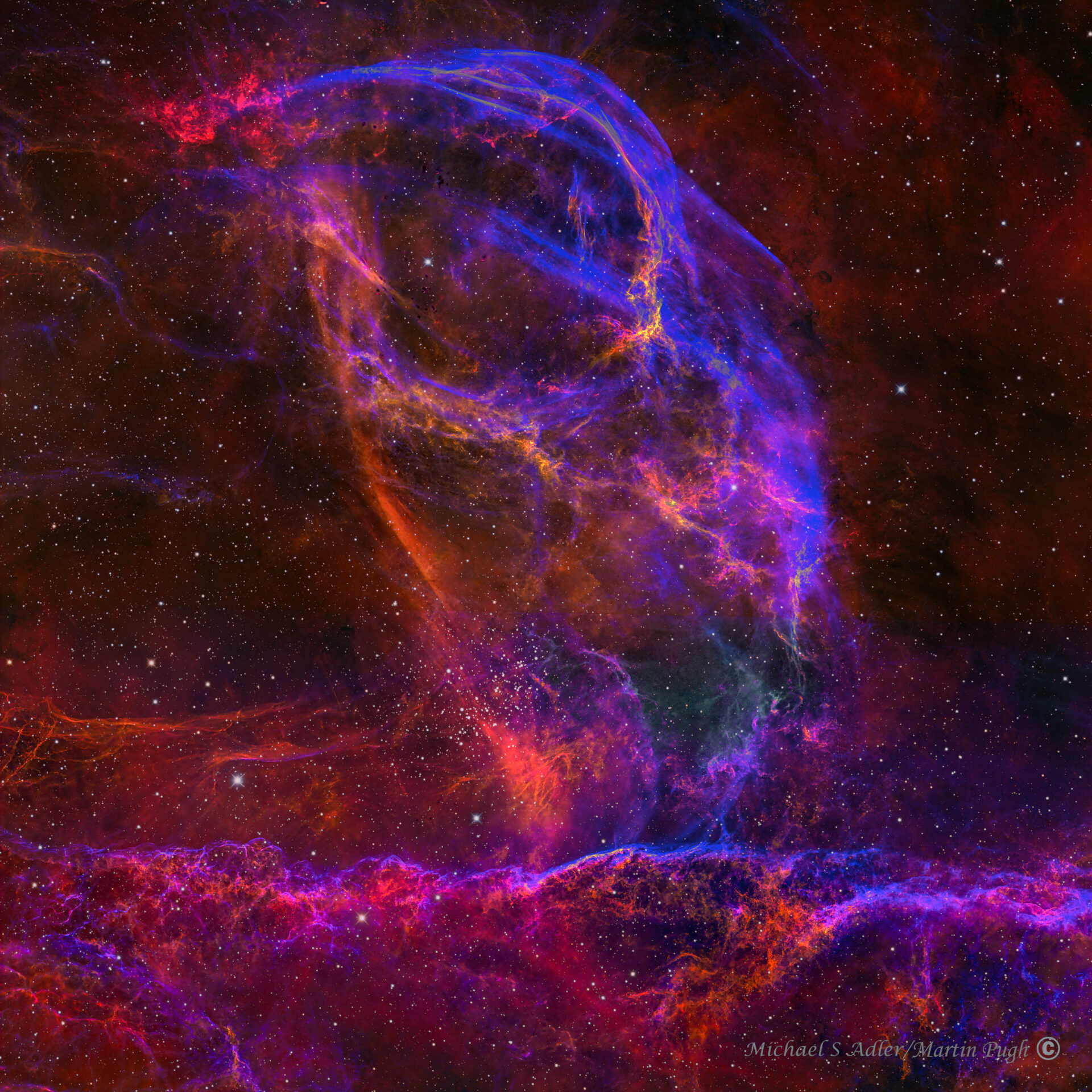
 NGC 2659,  This two-panel mosaic  shows the delicate filaments of the vast Vela Supernova remnant located in the southern Vela constellation at a declination of -50 degrees. In the orientation of this image it appears to be a giant, colorful, cosmic bird sitting on its nest eating a fiery fly.  The supernova remnant is at a distance of only about 800 light-years, making it one of the nearest known remnants of a stellar explosion that occurred roughly 11,000 years ago. These faint structures appear as intricate wisps and curves of glowing gas stretching across the image. The emission is dominated by oxygen (OIII), which outlines the shock fronts in electric blue, interwoven with hydrogen (Hα) glowing deep red. Contributions from sulfur (SII), mapped here in subtle orange tones, enrich the color palette and emphasize regions where the expanding shockwave interacts with denser material.

In addition to the supernova remnant there is an open star cluster located in the lower middle of the image that has no relation to the supernova remnant and is 5000 light years distant. Across the entire field, these beautiful shapes of ionized gas weave through a dense field of stars belonging to the Milky Way. The result is a striking juxtaposition: the youthful brilliance of the cluster set against the ghostly remnants of an ancient stellar explosion whose expanding shockwaves continue to sculpt the surrounding interstellar medium.

Spanning over two square degrees of sky which is about 4 moon diameters and an actual size of 30 light years, the mosaic offers a sweeping view of this dynamic region, where star formation, stellar evolution, and the aftermath of a supernova coexist within the same cosmic landscape. The image was taken in Australia using the wide field Planewave DR350 telescope and involved 36 hours of imaging and 290 individual images.

Category:

Optics: Planewave 14″ DR350
Mount: 10 Micron GM2000
Camera: Movarian C3-61000
Filters: Movarian 3nm Ha, Oiii, Sii
Dates/Times: April 2026
Location: Martin Pugh Observatory, Heavens Mirror Obs, Australia
Exposure Details: Two panel Mosaic,Ha,Oiii,Sii total 290 images, 35hrs
Acquisition: MaxIm DL
Processing:  MaxIm DL for  stacking,stretching, color combine,  BlurX Terminator,StarX Terminator, Photoshop CC2025 for combining 2 panels into mosaic and final processing