
Sale!

Andromeda Galaxy, Messier 31 CDK20 (Crop)

Original price was: $65.00.Current price is: $52.50.

Andromeda Galaxy, Messier 31 is about 2.5 million light-years away from Earth. It is the nearest major galaxy to our own Milky Way Galaxy?  In fact, our Galaxy is thought to look much like Andromeda but is about half its size and contains 200 billion stars compared with the Andromeda which contains a trillion stars. Together these two galaxies dominate the Local Group of galaxies that are gravitationally bound together. The diffuse light from Andromeda is caused by its trillion stars. The several distinct stars that surround Andromeda‘s image are actually stars in our Galaxy. M31 is so distant it takes over two million years for light to reach us from there. The spiral arms of the Andromeda Galaxy are being distorted by gravitational interactions with two companion galaxies, M32 and M110 which are the two bright objects to the left and to the right of the Andromeda in the image. At a magnitude of 3.4, the Andromeda Galaxy is the most distant object you can spot with the naked eye. You need a good spot away from bright lights in order to see it. While most galaxies are moving away from us, the Andromeda is destined to collide with the Milky Way Galaxy in 5-7 billion years.

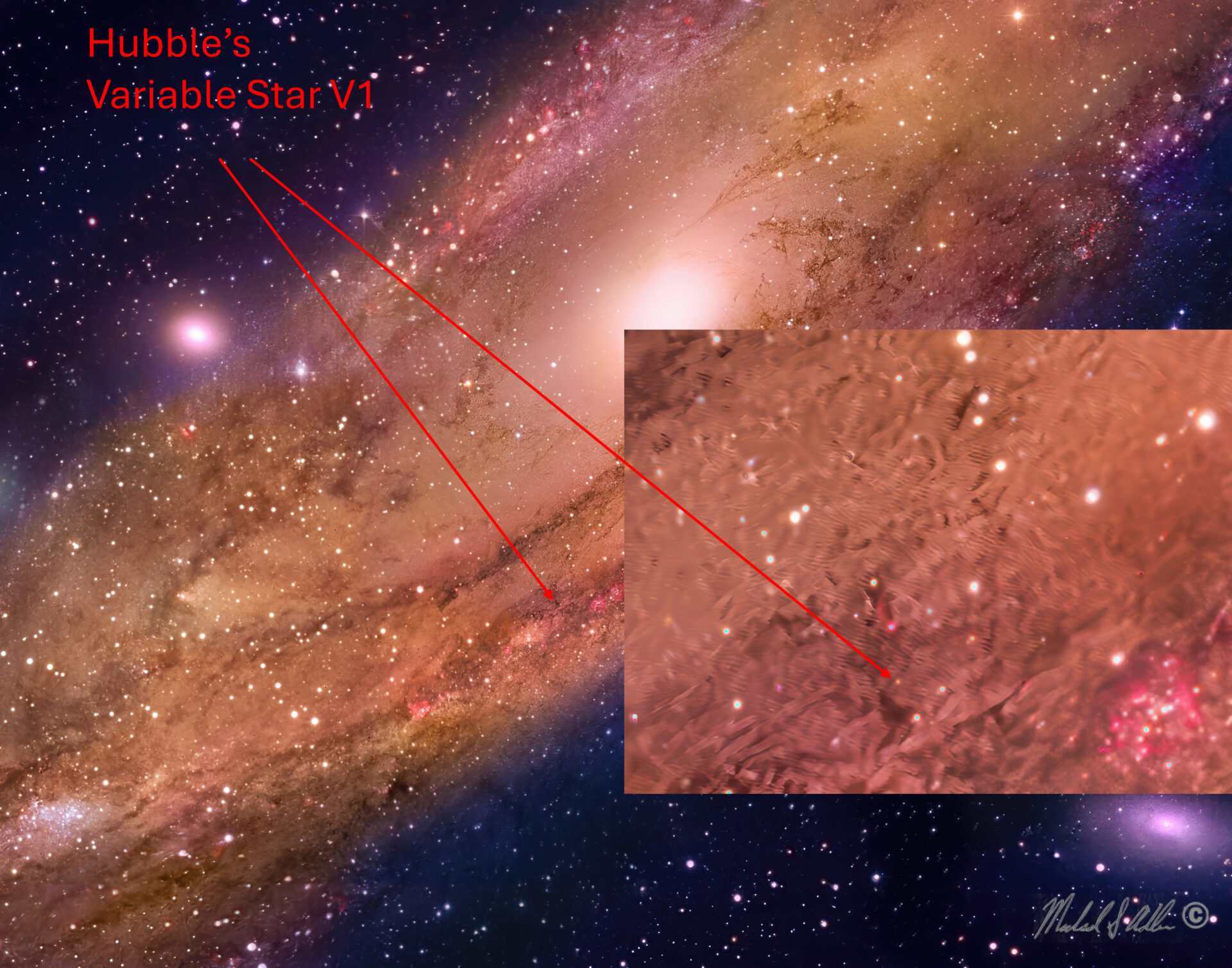
The Andromeda is also famous because Edmund Hubble in 1924 measured its distance to be millions of light years away and ended the “Great Debate” showing that these “spiral nebulas” were actually distant “island galaxies “ rather than nebulas within the Milky Way. This image of the Andromeda was made by a 11 panel mosaic done with the 20″ Planewave CDK20 telescope. The surrounding star field was done by scaling up an image done with the Takahashi 6″ FS152. The detail in the combined images provides great  resolution into the galaxy and this image is a cropped version of the complete image allowing more detail to be revealed. The inset is a further cropped version which shows that the V1 variable star used by Hubble in 1923 to determine that the Andromeda is actually outside the Milky Way. 

The small triangular cloud near the V1 can be seen in the larger image as well as the brighter star at the lower right corner. Careful inspection also reveals the V1 itself. One way to find the V1 is to use the triangular shaped set of stars to the right and slightly above which points to the general location of the V1.

The V1 star is 19’th magnitude and is about 0.6 micro arcsec in size. For comparison the smallest planet in the Solar System, Mercury, is about 10 arc seconds in the sky so V1 is over 10,000,ooo smaller as well as being 2.5 million light years distant. So resolving V1 is a major challenge.

Category:

Optics: PLanewave 20″ CDK20
Mount: Paramount MEII
Camera: FLI PL16803
Filters: FLI LRGB, Ha
Dates/Times: Oct 2026
Location: Earth and Sky Observatory, Jackson Hole WY
Exposure Details: CDK20, L,R,G,B=10m x 44, total 220 images , over 37hrs
Acquisition: MaxImDl, SkyX, Guiding Takahashi FSQ85, SBIG STF 8300m
Processing: MaximDl for calibration, stacking, color combination, BlurX  for deconvolution,   Photoshop 2025 for mosaic assembly and final processing