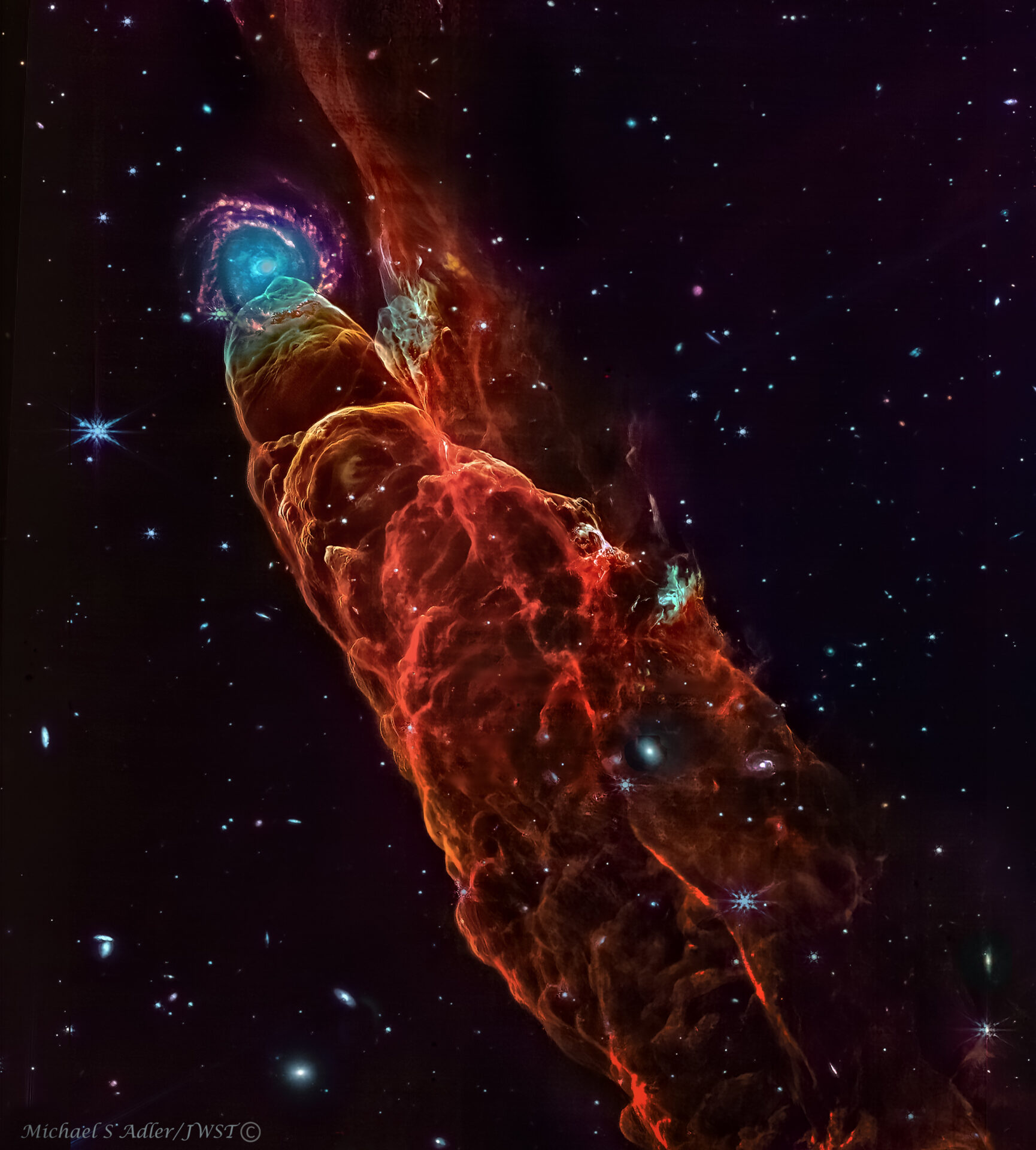
Herbig-Haro 49/50(JWST) (Vertical)
$65.00 Original price was: $65.00.$52.50Current price is: $52.50.
Herbig-Haro 49/50, JWST, The NASA/ESA/CSA James Webb Space Telescope observed Herbig-Haro 49/50, an outflow from a nearby still-forming star, in high-resolution near- and mid-infrared light with the NIRCam and MIRI instruments. Harbig-Haro objects are bright patches of nebulosity associated with newborn stars. They are formed when narrow jets of partially ionized gas ejected by stars collide with nearby clouds of gas and dust at several hundred kilometers per second. It is located in the southern constellation of Chamaeleon at -77 degrees south and is 650 light years away. The intricate features of the outflow, represented in reddish-orange color, provide detailed clues about how young stars form and how their jet activity affects the environment around them. A chance alignment in this direction of the sky provides a beautiful juxtaposition of this nearby Herbig-Haro object (located within our Milky Way) with a more distant, face-on spiral galaxy in the background.
Protostars are young stars in the process of formation that generally launch narrow jets of material. These jets move through the surrounding environment, in some cases extending to large distances away from the protostar. This ambient material is compressed and heats up, then cools by emitting light at visible and infrared wavelengths. In particular, the infrared light captured here by Webb highlights come from molecular hydrogen and carbon monoxide.The arc-shaped features in HH 49/50, similar to a water wake created by a speeding boat, point back to the source of this outflow. Based on past observations, scientists suspect that a protostar known as Cederblad 110 IRS4 is a plausible driver of the jet activity. Located roughly 1.5 light-years away from HH 49/50 (off the lower right corner of the Webb image), CED 110 IRS4 is a Class I protostar. Class I protostars are young objects (tens of thousands to a million years old) in the prime time of gaining mass. They usually have a discernable disk of material surrounding them that is still falling onto the protostar.
The galaxy that appears by happenstance at the tip of Herbig-Haro 49/50 is a much more distant spiral galaxy. It has a prominent central bulge represented in blue that shows the location of older stars. It also displays hints of “side lobes,” suggesting that this could be a barred-spiral galaxy. Reddish clumps within the spiral arms show the locations of warm dust and groups of forming stars. In the image background there are many more galaxies at further distances, including galaxies that shine through the diffuse infrared glow of the nearby Herbig-Haro object.
The image is in false color with red coming from the 7.7u wavelength captured by the medium infrared MIRI camera on JWST, green coming from the4.44u wavelength captured by the near infrared camera NIRCAM on JWST, and blue coming from the 3.35u wavelength also captured by the NIRCAM camera.