
Sale!

NGC 3372, NGC 3324 (DR350, CDK17 )

Original price was: $65.00.Current price is: $52.50.

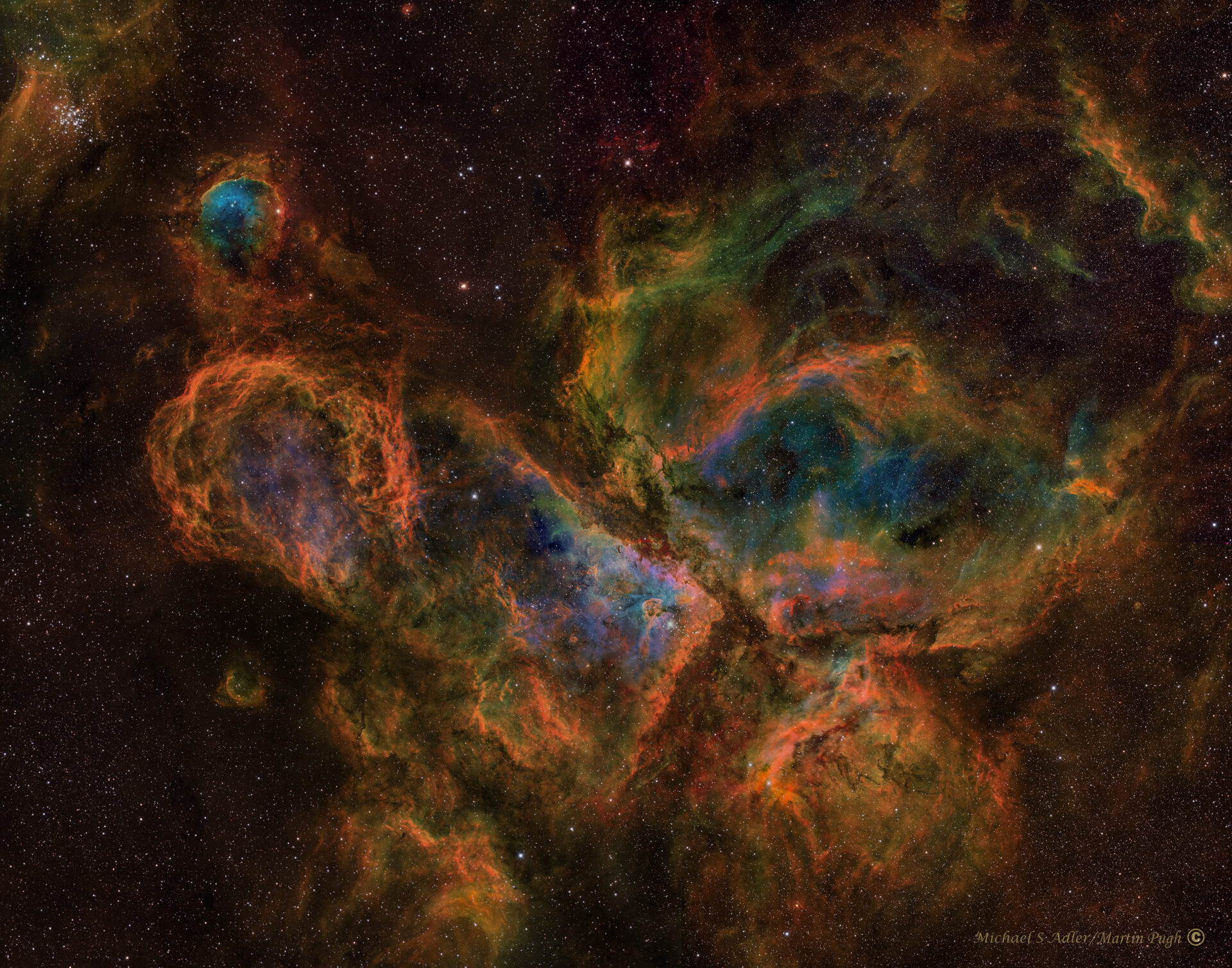
NGC 3324, NGC 3372  This four panel image shows the entire Carina nebula including NGC 3324, the Gabriela Nebula and NGC 3372 the Keyhole Nebula.  A jewel of the southern sky, the Great Carina Nebula,  spans over 300 light-years, one of our galaxy’s largest star forming regions. The bright star in the center is the Eta Carina and just to the left is the Keyhole Nebula. It is a small dark cloud of cold molecules and dust  containing bright filaments of hot, fluorescing gas, silhouetted against the much brighter background nebula. The diameter of the Keyhole structure is approximately seven light-years . In this image the keyhole is rotated to the left so it does not have the familiar shape. Its appearance has changed significantly since it was first observed, possibly due to changes in the ionizing radiation from Eta Carinae. Like the smaller, more northerly  Great Orion Nebula, the Carina Nebula is easily visible to the unaided eye, though at a distance of 7,500 light-years it is some 5 times farther away. The Carina Nebula is home to young, extremely massive stars, including the still enigmatic and violently variable Eta Carinae, a star system with well over 100 times the mass of the Sun.  While Eta Carinae is likely on the verge of a supernova explosion, X-ray images indicate that the Great Carina Nebula has been a veritable supernova factory. NGC 3324 is at the upper left corner of this image of the  Carina Nebula and goes by the name of the Gabriela Nebula. The entire Carina Nebula complex is located at a distance of roughly 7,200 light-years, and lies in the constellation Carina.

The image is done in narrowband with red coming from Sulfur emission, green from Hydrogen and blue from Oxygen. It is a four panel mosaic with inserts from the 17″ Planewave telescope bringing more detail to the Keyhole area and the Gabriela nebula in the upper left.


Category:

Optics: Planewave DR350 & Planewave 17″ CDK17
Mount: Software Bisque Paramount ME
Camera: Movarian, C3-61000
Filters: Astrodon 3nm Ha, Oiii, Siii, R,G,B
Dates/Times: March 2026, Feb 2026
Location: New South Wales Australia,& Rio Hurtado, El Sauce, Chile Martin Pugh Observatory
Exposure Details: Four Panels, Each panel, Sii,Ha,Oiii=18x5min,  total 452 images, 22 Hours
Acquisition: MaxIm DL
Processing: MaxIm DL to stack, stretch, plus create color images, Pixinsight  BlurX Terminator to take out the stars prior to processing the nebula, Photoshop  aligns four panels, integrates CDK17 images for the Keyhole Nebula and the  Gabriela Nebula,  and final processing.