
Sale!

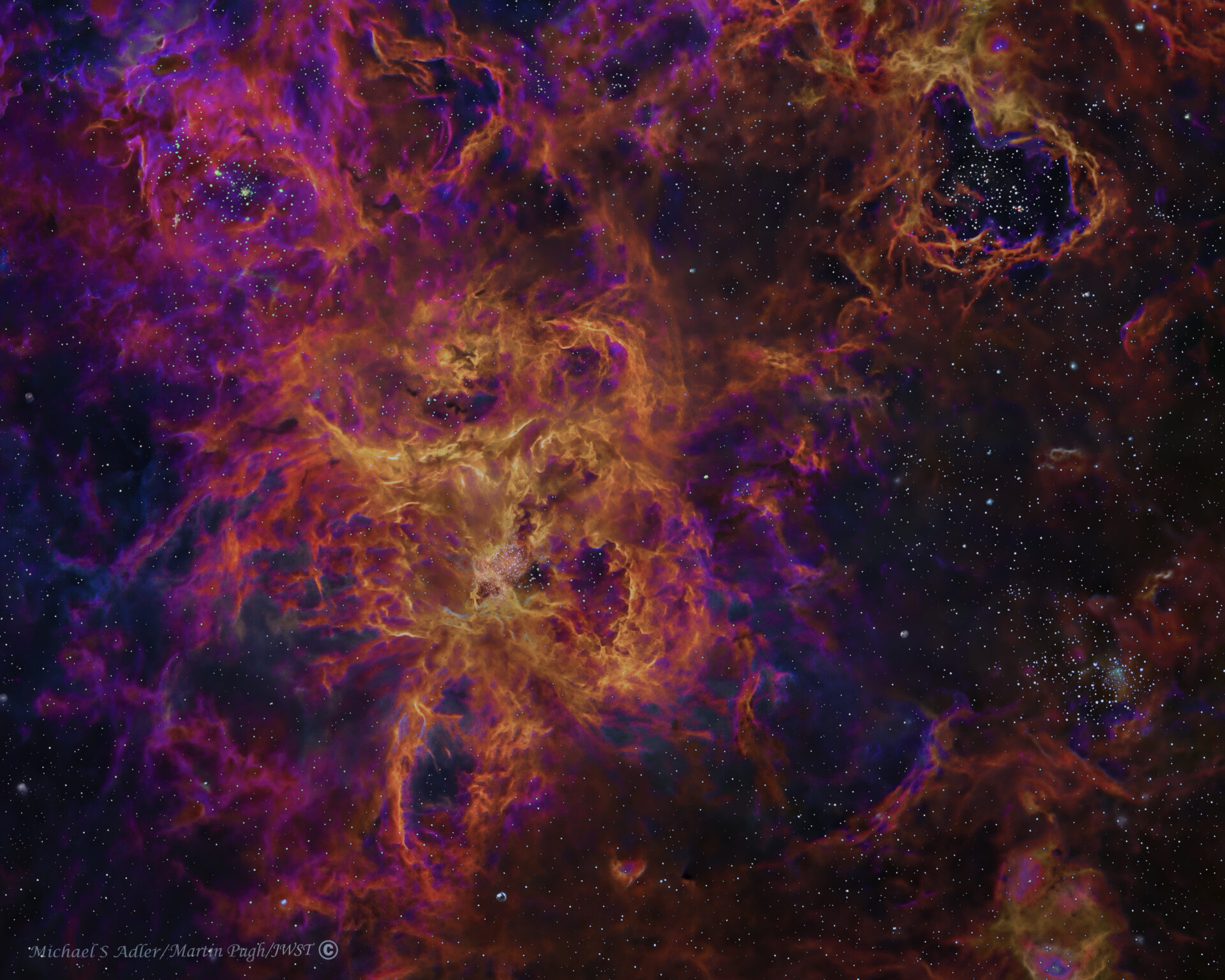
Tarantula Nebula, NGC 2070,DR350

Original price was: $65.00.Current price is: $52.50.

The Tarantula Nebula, NGC 2070  The Tarantula Nebula is more than a thousand light-years in diameter, a giant star forming region within nearby satellite galaxy the Large Magellanic Cloud. It is located at a declination of -69 degrees which is the celestial version of latitude and is only visible from the Southern Hemisphere.   About 180 thousand light-years away, it’s the largest, most violent star forming region known in the whole Local Group of galaxies. This distance is further away than any part of the Milky Way itself which is 110 thousand light years in size. The cosmic arachnid sprawls across this spectacular view, done with  atomic emission imaging.It also has a shape of a butterfly. The dominant red color is due to Hydrogen  emission, the yellow color is due to a mix of green from Sulfur emission and the red from the Hydrogen, and the blue is from oxygen emission. Within the Tarantula, intense radiation, stellar winds and supernova shocks from the central young cluster of massive stars,  energize the nebular glow causing the emission and shape the spidery filaments. Around the Tarantula are other star forming regions with many young star clusters, filaments, and blown-out bubble shaped clouds. The dominant large cluster in the lower right is NGC 2100. Above the central Tarantula nebula are two smaller nebulas with star clusters NGC 2050(left) and NGC 2081(right) inside of them The rich field of view spans about 1 degree or 2 full moons, in the southern constellation Dorado. But were the Tarantula Nebula closer, say 1,500 light-years distant like the local star forming Orion Nebula it would take up half the sky. The image data was taken from a remote telescope located at Heavens Mirror in New South Wales Australia and assembled in Jackson Hole into the image here .

Categories: ,

Optics: Planewave 14″ DR350
Mount: 10Micron GM2000
Camera: ZWO AST16200mm Pro
Filters: Astrodon 3nm Ha, Oiii, Siii
Dates/Times: November 2025
Location: New South Wales Australia, Martin Pugh Observatory
Exposure Details: R,G,B 10x 1min for stars, Ha,Oiii 25x 5min, Sii 50x 5min, 135 images over 9 hours
Acquisition: MaxIm DL
Processing:  MaxIm DL for stacking and stretching, Photoshop CC2025 for forming the HSO color image and final processing, and BlurX for deconvolution